

Lithium Ion Battery Production: Graphite Purification
Why Graphite Matters in Lithium Ion Battery Production
Graphite is the dominant material used in lithium-ion battery anodes, making it a critical enabler of the electrification economy. More than 95% of today’s EV batteries rely on graphite based anodes for conductivity, stability, and performance. As demand for electric vehicles and grid-scale energy storage grows, so too does the need for battery-grade natural graphite that meets stringent quality standards.
Industry analysts project rapid growth in graphite demand, driven by automotive OEMs and cell manufacturers racing to secure supply. For process engineers, this shift presents both opportunity and challenge: how to scale purification processes in lithium ion battery production to industrial capacity while ensuring the purity levels needed for safe, high-performing batteries.
The Challenge of Battery-Grade Graphite in Lithium Ion Battery Production
Natural vs. Synthetic Graphite
- Synthetic graphite is manufactured from petroleum coke and offers high purity but comes at significantly higher energy cost and environmental burden.
- Natural graphite, by contrast, is more sustainable and cost-effective but requires extensive purification to reach 99.95%+ carbon content required for battery-grade applications.
Purity Requirements
Battery manufacturers demand ultra-high purity graphite because even trace contaminants (iron, aluminum, silicon) can:
- Reduce electrical conductivity.
- Shorten battery cycle life.
- Pose safety risks during charging/discharging.
Processing Challenges
Producing high-purity natural graphite requires aggressive chemical processing:
- Use of corrosive acids such as hydrochloric or hydrofluoric acid.
- Large waste volumes from wash cycles.
- Risk of equipment corrosion, high labor intensity, and safety concerns.
Chemical Purification Methods in Lithium Ion Battery Production
1. Alkali Fusion Process
- Graphite is fused with caustic soda at high temperature, then leached with water and acid.
- Produces high purity but creates significant amounts of alkaline waste requiring treatment.
2. Acid Leaching Process
- Graphite is directly treated with hydrochloric or hydrofluoric acid to dissolve impurities.
- More scalable than alkali fusion, but handling aggressive acids poses safety and corrosion challenges.
The BHS Filtration Advantage
BHS Filtration brings process engineers a proven solution for lithium ion battery production by combining specialized equipment design with process efficiency.
Belt Filters for Corrosive Environments
- Constructed with corrosion-resistant polymer materials to withstand aggressive acid leaching processes.
- Engineered for continuous, high-volume purification of graphite.
- Integrated fume hood contains acid vapors and prevents exposure and corrosion to surrounding plant components.
Continuous, High-Capacity Operation
- Unlike batch filters, BHS systems operate without frequent stops, reducing downtime and manual intervention.
- Automation reduces the need for constant operator oversight, lowering labor costs and exposure risk while improving consistency.
Countercurrent Cake Washing – Why It Matters
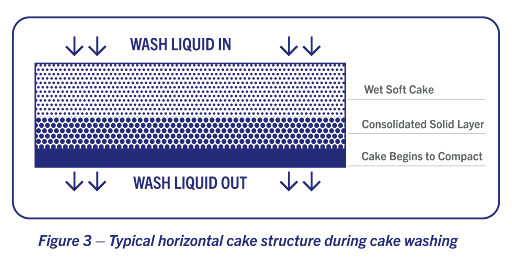
One of the most critical steps in graphite purification is washing the filter cake to displace impurities and residual mother liquor.
- Filter Press Limitations:
Traditional filter presses are often described as producing “well-washed cakes.” However, as the technical literature shows, these washes are rarely efficient. Filter presses:- Produce thick, two-sided cakes with compacted outer layers, which make uniform washing difficult.
- Require higher pressures to push wash fluid through both sides of the cake.
- Suffer from back-mixing, where wash liquid bypasses rather than displaces impurities.
- Typically consume 3–4 times more wash water and can require washing cycles lasting 8 hours or more.
- BHS Belt Filter Advantage:
By contrast, BHS belt filters wash on one side only, with thinner cakes and wash fluid traveling in the same direction as the expelled mother liquor. This design:
- Enables true countercurrent displacement washing rather than back-mixing.
- Reduces wash water consumption significantly, nearly matching the theoretically optimal wash ratio.
- Shortens cycle times dramatically, supporting continuous throughput.
- Achieves the 99.95%+ purity required for battery-grade graphite with greater consistency.
In practical terms: while a filter press may require operators to “over wash” graphite for hours to ensure consistent purity, BHS belt filters deliver consistent results in a fraction of the time, with less water and lower energy demand.
Sustainability & Efficiency Gains
For process engineers and plant operators, the implications of BHS’s continuous filtration systems extend beyond technical performance:
- Higher Efficiency – Continuous operation eliminates downtime between batches, increasing throughput and productivity.
- Lower Labor Requirement – Operators are no longer required to repeatedly load, unload, and restart filters. Instead, one technician can monitor multiple lines simultaneously, freeing staff for higher-value tasks such as process optimization.
- Improved Safety – Reduced manual intervention lowers exposure to corrosive acids and hazardous environments.
- Water & Energy Savings – Countercurrent washing minimizes fresh water use, reduces wastewater volumes, and shortens washing cycles—helping plants meet sustainability targets.
As demand for electric vehicles and energy storage accelerates, the challenge of producing battery-grade natural graphite will only grow. Achieving the required 99.95% purity at industrial scale demands more than traditional batch-based systems can deliver.
With continuous belt filters, corrosion-resistant construction, and highly efficient countercurrent washing, BHS Filtration helps chemical engineers and plant operators meet the dual goals of purity and scalability in lithium ion battery production.
Ready to learn more? Contact us and speak with a BHS engineer to learn how we can optimize your battery materials process.