

Purity and Scalability in Lithium Ion Battery Materials Production
The Growing Demand for Lithium-Ion Batteries
The global transition to electric mobility and renewable energy storage has placed lithium ion battery materials production at the center of the clean energy economy. Electric vehicles (EVs) are driving exponential demand for battery-grade materials, while grid-scale storage systems are expanding the reach of wind and solar power.
This growth comes with significant challenges. Battery manufacturers must secure supply chains that are not only scalable but also capable of meeting the extreme purity requirements necessary for high-performance batteries. At the same time, environmental regulations and sustainability goals are forcing companies to rethink how critical materials are produced, processed, and recovered at the end of life.
To achieve this balance, chemical engineers and plant operators require reliable process engineering and advanced filtration solutions that can scale with demand while reducing waste and environmental impact.
Mapping the Lithium-Ion Battery Value Chain
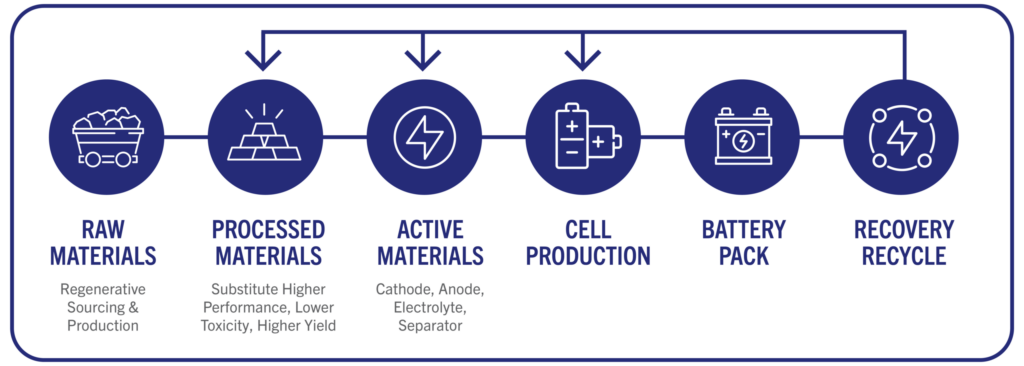
The value chain for lithium-ion batteries stretches across continents, with multiple critical stages that influence quality, cost, and sustainability:
- Mining & Raw Material Sourcing – Extraction of lithium, nickel, cobalt, and natural graphite.
- Material Processing & Purification – Refining raw materials into high-purity, battery-grade inputs.
- Cathode and Anode Production – Manufacturing active materials that determine battery performance.
- Cell Assembly & Manufacturing – Building cells with precision at scale.
- Pack Integration – Combining cells into modules and packs for use in EVs and stationary storage.
- End-of-Life Recycling & Reuse – Recovering valuable materials and reducing reliance on mining.
Key Challenges in the Battery Supply Chain
As the industry scales, several challenges threaten efficiency and reliability:
- Purity of Critical Materials: Even trace levels of impurities in lithium, cobalt, or graphite can impact conductivity, cycle life, and safety.
- Environmental Concerns: Traditional chemical purification methods often rely on corrosive acids and generate large volumes of wastewater.
- Efficiency in Recycling vs. New Mining: Recycling technologies must compete economically with mined materials while delivering equivalent quality.
- Balancing Cost with Sustainability: Manufacturers are under pressure to reduce costs while meeting stricter environmental and social governance (ESG) standards.
Where BHS Filtration Adds Value
BHS Filtration delivers proven solutions at three key points in the lithium ion battery materials production value chain. Each application is linked to dedicated deep-dive articles for engineers seeking process-specific insights.
1. Materials for Production of New Lithium Ion Batteries – Graphite Purification
- Continuous filtration of natural graphite to produce high-purity anodes.
- Reliable in acid leaching and alkali fusion purification processes.
- Designed for corrosive chemical environments while reducing water usage.
2. Hydrometallurgical Battery Recycling
- Enables efficient separation of impurities after acid dissolution.
- Facilitates recovery of valuable metals like nickel, cobalt, and lithium.
- Ensures scalability of recycling systems without downstream blockages.
3. Direct Recycling Processes – Dry Processing
- Specialized vacuum drying systems to recover electrolytes and prepare components for reuse.
- Supports innovative direct recycling methods that minimize chemical consumption.
The BHS Process Advantage
For chemical engineers tasked with scaling operations, BHS filtration systems deliver measurable advantages over traditional methods:
- Continuous Operation vs. Batch – Eliminates downtime, reduces manual intervention, improves safety and lowers labor costs due to automatic processing and minimal monitoring.
- Corrosion-Resistant Equipment – Designed with specialized polymers to withstand aggressive chemical processes.
- Water-Efficient Cake Wash Mechanisms – Countercurrent washing technology minimizes freshwater use and wastewater generation. The mechanical configuration of the machine, combined with the method of wash addition allows for highly efficient displacement washing; approaching the theoretically optimal rates.
- Proven Track Record – BHS systems are deployed globally in battery-grade material production and recycling, demonstrating performance across industries.
These benefits translate to higher throughput, lower operational costs, and more sustainable production systems.
Looking Ahead: The Future of Battery Supply Chains
The future of lithium ion battery materials production is shaped by shifting policies, market demands, and sustainability imperatives:
- Policy & Regulation Shifts – Initiatives like the EU’s Battery Passport and the U.S. Inflation Reduction Act (IRA) mandate greater transparency and sustainability in material sourcing and processing.
- Closed-Loop Systems – Companies are moving toward circular supply chains, where recycling feeds directly back into production.
- Advanced Filtration as an Enabler – Continuous filtration technologies will be essential for achieving both purity and scalability, ensuring consistent quality while lowering environmental impact.
The lithium-ion battery revolution depends on a supply chain that can deliver pure, scalable, and sustainable materials. BHS Filtration is uniquely positioned to support chemical engineers and process leaders in three critical areas:
- Graphite purification for new battery materials
- Hydrometallurgical recycling for critical metal recovery
- Direct recycling processes with advanced drying technologies
By combining continuous operation, corrosion resistance, and water-efficient designs, BHS helps manufacturers meet the dual challenge of scaling production while minimizing environmental impact.
Book a consultation with a BHS engineer today to explore solutions for your facility.