

How Bench-Scale Filtration Testing Reduces Capital Investment Risk
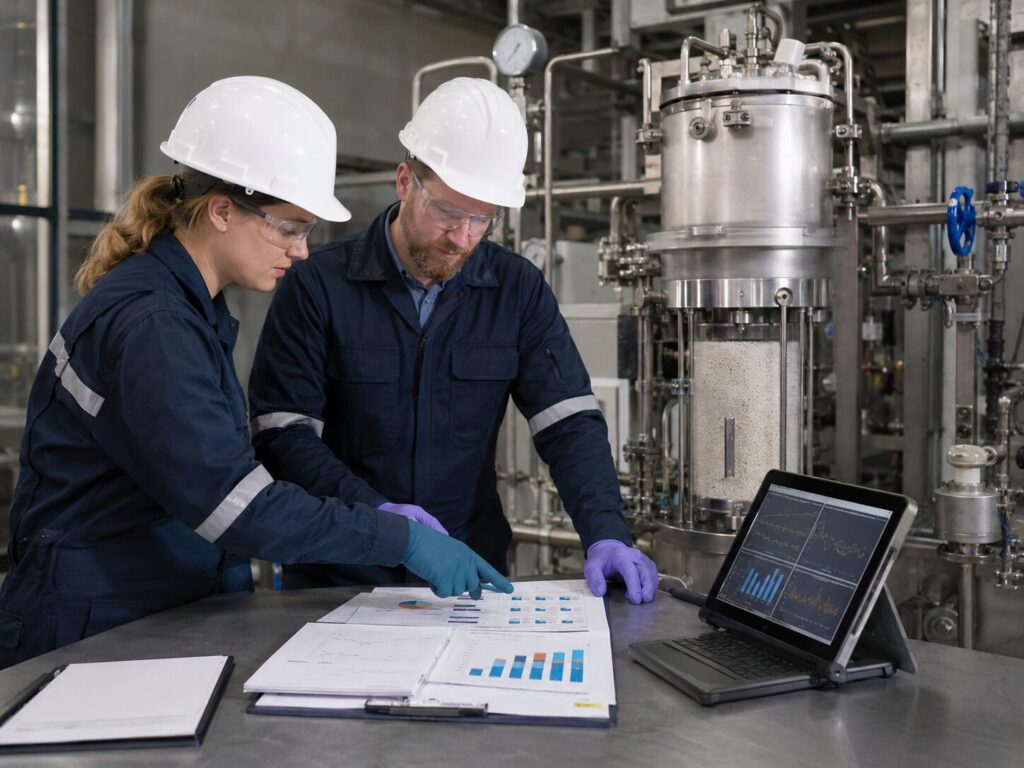
Selecting filtration equipment without process-specific test data introduces risk that is difficult to manage at commissioning. Bench-scale filtration testing exists to eliminate that risk before capital is committed. A filter that appears correct on paper, based on particle size estimates and assumed cake resistance, can perform very differently on the actual process slurry. Finding that out in a lab test costs days. Finding it out after equipment is installed can cost months and a significant portion of the project budget.
For process engineers in the chemical process industry and new technology applications, the path from laboratory synthesis to full-scale commercial production involves multiple scale-up decisions. Each one carries assumptions, and each assumption is an opportunity for error. Filtration is particularly sensitive to scale-up because even small changes in slurry characteristics, particle size distribution, or solids concentration can shift cake resistance, wash efficiency, and drying behavior in ways that are difficult to predict without measured data.
This post explains what bench-scale filtration testing covers, how the resulting test report informs equipment selection and process design, and how BHS Filtration supports process development from bench to full-scale plant.
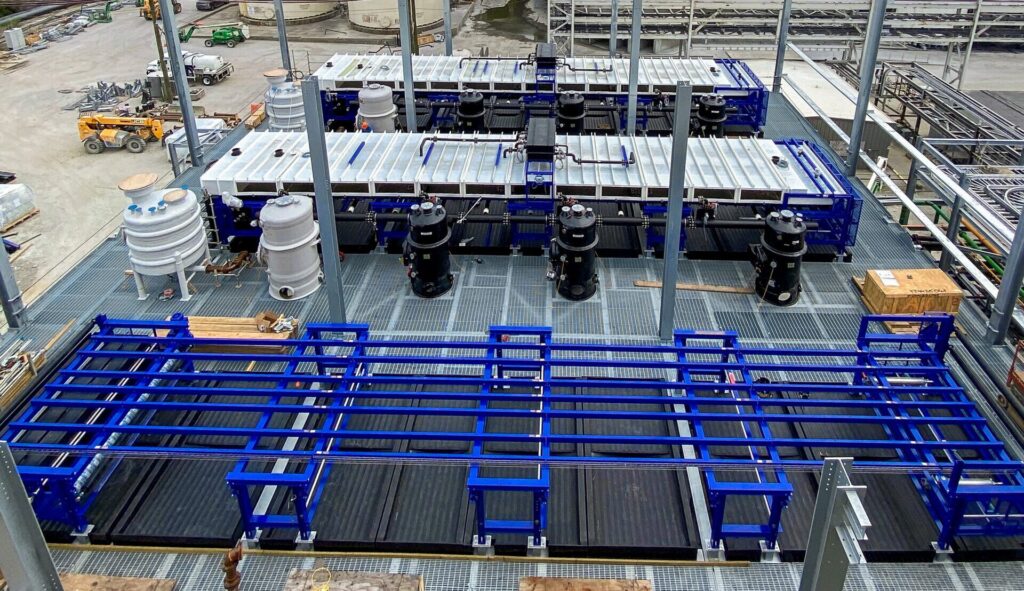
Why Filtration Scale-Up Risk Is Hard to Eliminate Without Test Data
Filtration performance is process-specific. Unlike many unit operations, it cannot be reliably predicted from first principles alone. The behavior of a slurry under filtration depends on a combination of factors: particle size and shape, solids concentration, cake compressibility, the interaction between the filter media and the solids, and the conditions under which washing and drying are performed.
Two slurries with similar particle sizes and solids loadings can produce filter cakes with dramatically different resistance values and wash efficiencies. A filter press that handles one material reliably may produce inconsistent cakes on a different feed. A vacuum filter that achieves target moisture on one slurry may fall short on a slightly different composition.
The consequence of skipping process development filtration testing is not just a performance gap at startup. At the pilot or demonstration scale, it can mean months of troubleshooting a technology that was selected on assumptions. At commercial scale, it can mean permanent throughput constraints or product quality problems that require re-engineering after installation.
Process engineers who begin with accurate bench-scale data are not being overly cautious. They are applying the standard method for converting assumptions into measured facts before capital decisions are made.
What Bench-Scale Filtration Testing Covers
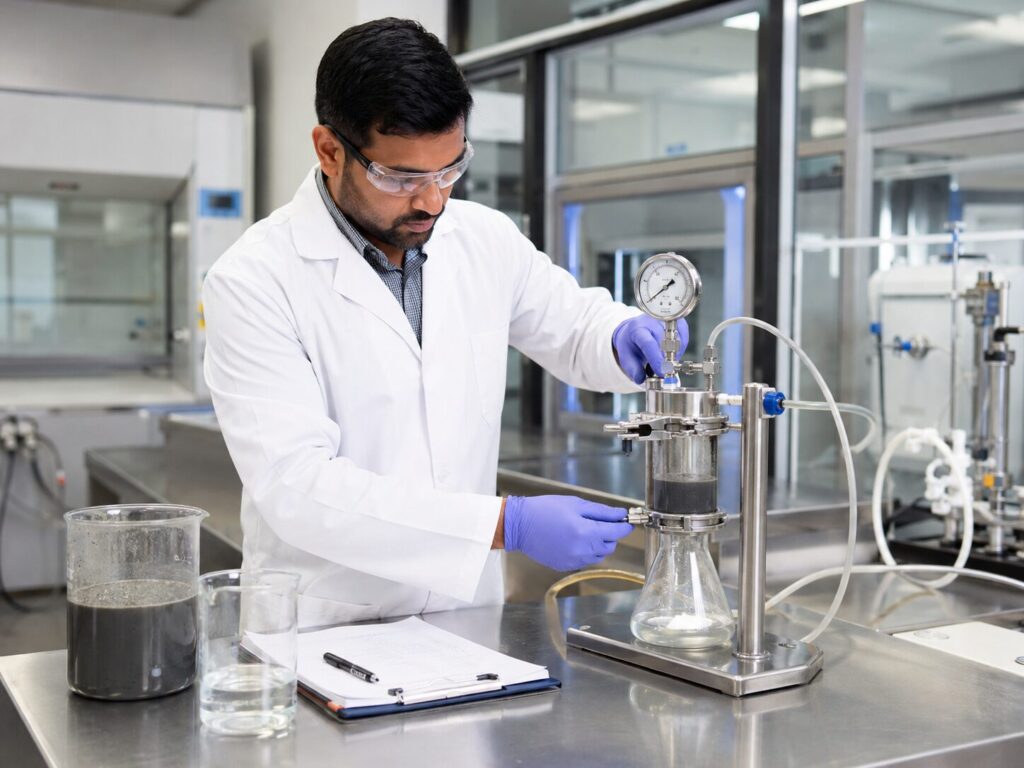
BHS conducts bench-scale testing using the BHS Pocket Leaf Filter, a compact pressure and vacuum test device with a filter area of 20 cm². The device allows engineers to evaluate core filtration parameters on a small sample of the actual process slurry before any pilot equipment is specified.
A structured lab-scale filtration test covers four areas:
Cake formation. Testing evaluates how the filter cake builds under pressure or vacuum, including cake depth, formation time, and the relationship between operating pressure and cake resistance. Filter media selection is determined at this stage. The choice of a suitable filter cloth directly affects filtrate clarity, cake structure, and discharge quality.
Wash performance. The test measures wash ratios required to achieve target product purity or impurity removal, the efficiency of displacement washing, and whether counter-current washing is necessary. For processes with tight purity specifications, wash efficiency data from bench testing is the foundation for zone configuration in the full-scale system.
Drying behavior. Cake moisture targets and drying technique are validated at the bench scale. Testing determines whether vacuum drying, gas blowing, mechanical pressing, or a combination is needed and what cycle time achieves the target residual moisture consistently.
Scale-up parameters. All measurements from bench testing feed directly into the scale-up calculation for the commercial unit, including cake thickness, filtration cycle time, wash ratios, and solids throughput per unit area. These parameters determine filter area requirements and zone configuration at full scale.
The BHS Pocket Leaf Filter uses a standardized data collection sheet to ensure every test captures the same parameters, making it straightforward to compare results across different filter media, operating pressures, or process conditions.
How a Filtration Test Report Informs Equipment Selection
The output of bench-scale testing is not a data table. It is a written filtration test report that translates measured performance into actionable scale-up recommendations.
A structured test report documents the process description, slurry characteristics, the operating conditions tested, and the results for each phase of filtration. It also includes the recommended technology and configuration for the scaled system. For complex processes, it may compare results across multiple filter media or operating pressures to show the sensitivity of performance to process variables.
This document serves multiple functions across the project lifecycle. For engineering teams, it provides the validated basis for equipment specification. For procurement, it supports cost estimation by defining the required filter area, zone count, and ancillary equipment. For project management, it provides the technical justification for technology selection that all stakeholders can review before capital is committed.
It also provides a reference point if the commercial plant deviates from expected performance. Process engineers who can show tested conditions and observed results are in a fundamentally stronger position than those working from assumed or extrapolated data.
From Lab to Pilot to Commercial Scale: A Practical Example
The filtration scale-up from bench to commercial rarely follows a straight path. A case history from BHS process development illustrates how bench-scale testing prevented a costly commitment from compounding across project stages.
Initial lab-scale filtration testing on a low-solids slurry at 1.8 percent solids indicated pressure filtration using candle filters. Two candle filters were installed at the pilot stage, each with 0.2 m² of filter area. After the pilot began, the selected filter media did not produce the required solids removal, cake discharge was difficult, and displacement washing was inefficient at the tested ratio of 10 kg liquid to 1 kg solid. Drying was also problematic, with inconsistent cake thickness and cracking.
Rather than advancing to the demonstration scale with the same technology, the team returned to bench-scale testing. The second round of filtration pilot testing shifted focus to vacuum filtration. Solids concentration was increased from 1.8 to 7 percent, improving filterability. A 7-micron filter media produced clear filtrate with no detectable fines. Cake thickness was reproducible at 50 mm, and displacement washing with water achieved efficiency above 90 percent. Drying with vacuum, mechanical pressing, and blowing produced consistent residual moisture within a defined 50-second cycle time.
Based on the second round of lab results, the demonstration scale plant used a continuous-indexing vacuum belt filter. The demonstration plant validated the laboratory data across extended run times. The commercial plant was then designed based on confirmed performance from both the bench and the demonstration unit.
The takeaway is not that the initial technology selection was wrong. It is that the process to identify the correct technology worked as it should. Each stage produced data that informed the next, and no large capital commitment was made until performance was validated at the previous scale.
How BHS Supports Process Development from Bench to Plant
BHS Filtration operates a process development lab in Charlotte, North Carolina, equipped to conduct bench-scale and pilot testing across the full range of BHS technologies, including the Rotary Pressure Filter, the Continuous-Indexing Vacuum Belt Filter, and the Candle Filter.
Process development filtration testing at BHS follows a structured sequence: process description and slurry characterization, filter media screening, filtration and washing testing, drying evaluation, and documentation of results in a written test report with scale-up recommendations. For processes requiring more extended run times or larger sample volumes, pilot rental units are available for on-site testing that bridges bench results and commercial-scale equipment decisions.
All bench and pilot testing produces documented results that can be reviewed and validated before capital is committed. BHS does not recommend a technology or system configuration without test data to support it. The Application Data Sheet is the starting point: it captures the key slurry and process parameters that form the basis for the testing plan and ultimately the scale-up recommendation.
The Test Report Is the Decision Document
A filtration test report does more than confirm that a technology works. It defines the operating window, identifies the process sensitivities, and provides the documented basis for the capital commitment that follows. For process engineers working through a filtration scale-up, it is the document that converts assumptions into measured facts.
The cost of running a bench-scale test is small relative to the cost of discovering a technology mismatch at the pilot or commercial stage. Starting with the data is the standard practice for a reason.
Submit your Application Data Sheet to start the testing conversation with BHS Filtration’s process development team.