
Fermentation Filtration Case Study: Refurbishment of BHS Rotary Pressure Filter for Artificial Sweetener Production
High-Purity Sweeteners and the Role of Fermentation Filtration
Artificial and high-intensity sweeteners sit right alongside plant-based proteins, organic acids and amino acids as part of the broader “bio-based food and ingredient” world. Whether produced by chemical synthesis, enzymatic catalysis or fermentation, all of these products depend on robust fermentation filtration and crystallization steps to reach food-grade quality.
Compounds like sucralose and aspartame are great examples. Sucralose is obtained through selective chlorination of sucrose, while aspartame is created via peptide coupling of amino acids in a chemical or enzymatic process. Regardless of the exact reaction route, once synthesis is complete the process converges on a familiar sequence:
- 1. The reaction slurry is cooled or conditioned so that the target sweetener crystallizes.
- 2. Crystals are separated from the mother liquor.
- 3. The crystal cake is washed to remove residual reactants, by-products, color bodies and catalysts.
- 4. The washed cake is dewatered as far as possible before drying and packaging.
The separation and washing step is where filtration earns its keep. The equipment must be hygienic, capable of complete solids capture, and able to deliver low residual moisture so the dryer isn’t overloaded. When filtration underperforms, the result is higher energy use, yield losses and quality issues, all in a process stream where every kilogram of product is valuable.
The Challenge: Centrifuges with High Losses and Reliability Issues
Increasingly, plant-based protein lines are incorporating fermentation to improve their products. Fermentation can soften or transform off-flavor compounds, add dA producer of artificial sweeteners approached BHS with exactly these problems. The plant manufactured a high-value, crystallized sweetener and relied on centrifuges to separate crystals from mother liquor after crystallization.
Over time, the centrifuges had become a liability:
- Fine crystals routinely bypassed the centrifuge baskets and were lost with the centrate, directly impacting yield.
- Cake discharge was inconsistent and often required manual scraping and intervention, leading to unplanned downtime.
- Cleaning and inspection were cumbersome, making it difficult to meet internal expectations for sanitary processing.
In effect, the centrifuges were undermining both productivity and product recovery. The plant wanted to modernize this part of the line with a technology that could:
- Operate continuously instead of in short batch cycles.
- Capture even the finest crystals without loss.
- Provide excellent cake washing and low residual moisture to ease the load on the dryer.
- Meet stringent food-grade and cleanability requirements.
Evaluating Alternatives: From Bench Tests to Pilot Rotary Pressure Filter
BHS began with a familiar first step: bench-scale filtration tests on representative sweetener suspensions. These tests explored how the crystals behaved as a filter cake—how quickly they formed, how compressible they were, and how easily they could be washed and dewatered.
The test data quickly suggested that a thin-cake pressure filter, rather than another generation of centrifuges, would be a much better fit. In particular, the BHS Rotary Pressure Filter (RPF) showed strong potential because it:
- Forms a uniform, relatively thin cake that is ideal for efficient washing.
- Operates in a fully enclosed, gas-tight housing—important for solvent- or alcohol-based washes.
- Can be configured for multiple wash zones, followed by final dewatering and cake discharge, all in one continuous system.
To validate the lab findings, BHS and the customer moved to pilot trials using a small production RPF. These trials confirmed that:
- Complete solids capture was achievable, with no visible fines passing into the filtrate.
- Counter-current cake washing easily met impurity specifications.
- Residual moisture from the RPF cake was low enough to fit comfortably within the capacity of the existing dryer.
With lab and pilot data aligned, the plant team agreed that a full-scale BHS Rotary Pressure Filter would be the best technology to replace the centrifuges.
The Twist: Aggressive Schedule and Limited Installation Window
At this point, the project faced a non-technical challenge. The customer had a narrow shutdown window for installation. If the filter could not be delivered and installed within that timeframe, the upgrade would need to wait until the following year, delaying the productivity gains and prolonging the issues with the existing centrifuges.
Standard lead times for a new, custom-built food-grade RPF would not comfortably fit this schedule. The team needed a creative solution that could deliver:
- The right filter size and configuration to match the pilot results and plant throughput.
- Full food-grade execution, including materials of construction and sanitary design details.
- A significantly shorter delivery time than a new-build machine.
Unlocking Value in the BHS Fleet: Identifying a Refurbishment Candidate
One of the advantages of working with a global supplier like BHS is the visibility into installed equipment across different regions and industries. In reviewing the worldwide fleet, the BHS team identified a promising opportunity:
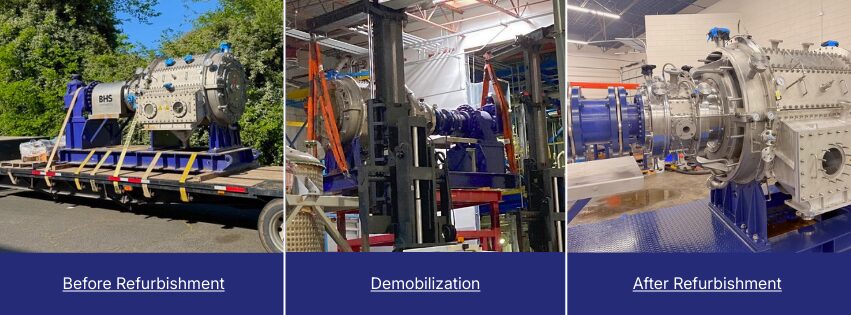
A food-grade Rotary Pressure Filter of the appropriate size had recently come out of service in another application and was sitting idle. The machine had the basic mechanical configuration and housing design required, and its filter area matched the throughput targets established during pilot testing.
Rather than starting from scratch, the team proposed a refurbishment project:
- The existing unit would be demobilized from storage.
- All process-wetted components would be inspected, cleaned and reworked as needed.
- The filter would be rebuilt with new, fully compliant food-grade wear parts and elastomers.
- Controls and auxiliary systems would be updated to match the customer’s plant standards.
This approach offered a way to meet throughput and sanitary requirements while dramatically shortening lead time, allowing installation within the current year’s shutdown window.
Refurbishment in Practice: From Idle Machine to Food-Grade RPF
Working in close coordination with the end user, BHS executed the refurbishment in several stages.
1. Demobilization and inspection
The filter was transported to a BHS facility, fully disassembled and stripped down to its frame and pressure housing. Stainless steel parts were inspected for wear, corrosion and dimensional integrity. Where needed, components were repaired or replaced.
2. Deep cleaning and surface preparation
All internal and external stainless surfaces underwent thorough cleaning to remove any residues from the previous application. Surface finishes in process-wetted areas were verified and improved where necessary to support hygienic operation and cleanability.
3. Replacement with food-safe materials
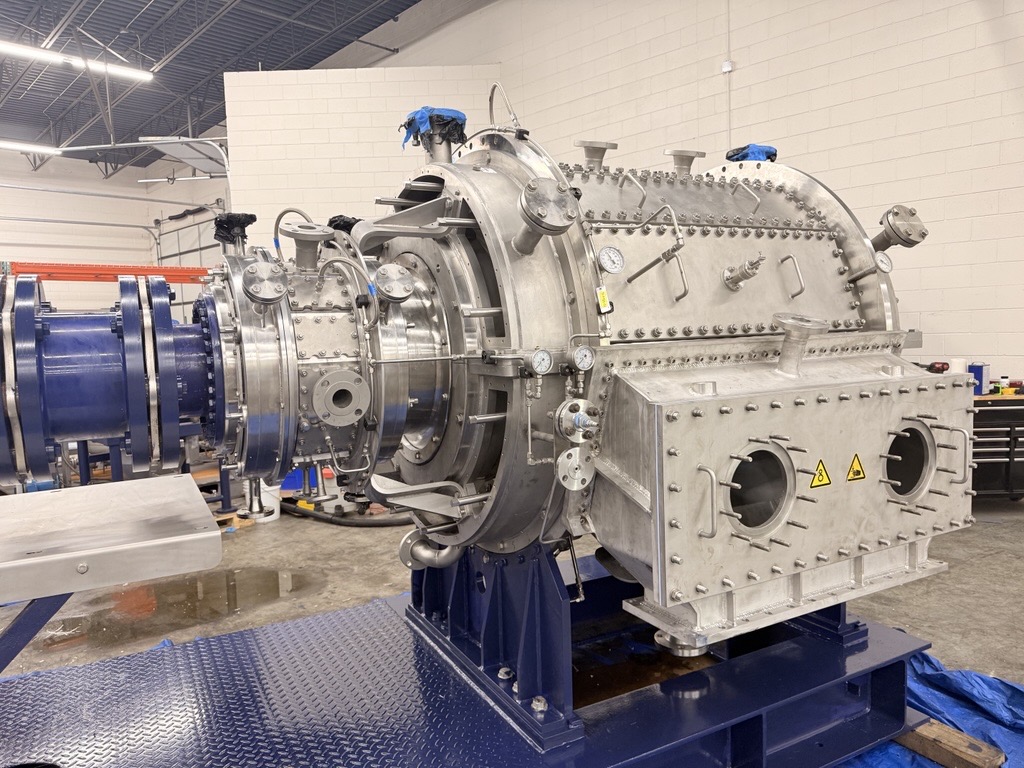
New filter media, seals, gaskets and other elastomeric components were installed, all selected to meet the customer’s food-grade requirements and local regulatory expectations. Where appropriate, modern inflatable seals and upgraded cleaning nozzles were incorporated to improve containment and CIP performance compared to the original design.
4. Reassembly, testing and controls integration
The RPF was reassembled with updated drive components and instrumentation. Factory acceptance tests (FAT) verified mechanical operation, integrity under pressure and correct function of the washing and dewatering zones. Controls were configured so the RPF could integrate cleanly into the plant’s automation system.
Because the base machine structure already existed, these steps could be completed much faster than a new build project, all while delivering a filter that behaved like a new unit from the operator’s perspective.
Results: Clean Separation, Reduced Losses and a Faster Path to Productivity
Once installed, the refurbished Rotary Pressure Filter replaced the problematic centrifuges and quickly demonstrated why thin-cake continuous filtration is so attractive for crystallized sweeteners.
- Cleanability and sanitary processing improved markedly. The enclosed RPF housing, smooth internal surfaces and integrated CIP nozzles simplified cleaning between campaigns and supported the plant’s quality and audit requirements.
- Complete solids capture became the norm rather than the exception. Fine crystals that had previously slipped through centrifuge screens were now retained in the filter cake, boosting overall yield and making filtrate polishing simpler.
- Lower residual moisture reduced the burden on the dryer. With a drier cake entering the drying step, energy use decreased and drying times stabilized, helping the plant run closer to its design capacity.
- Operator involvement and unplanned downtime dropped. Automatic cake discharge and consistent filtration behavior reduced the need for manual intervention, turning what had been a problem area into a largely “background” operation.
Most importantly, all of this was achieved within the customer’s tight project schedule, thanks to the refurbishment approach. Instead of waiting another year for their filtration upgrade, the plant was able to start realizing benefits almost immediately.
Takeaways: Proven Fermentation Filtration with a Pragmatic Approach
This case study highlights that fermentation filtration challenges are often best solved by rethinking the separation technology itself. For crystallized products coming out of fermentation or downstream synthesis, continuous thin-cake pressure filtration can deliver clear advantages over centrifuges in terms of yield, moisture control, wash efficiency and operational stability.
The results demonstrate that BHS Rotary Pressure Filters are well suited to demanding fermentation filtration and crystallization duties, consistently achieving complete solids capture, effective impurity removal and low residual moisture in high-value applications. Just as importantly, they show that successful projects are not only about equipment selection, but also about how solutions are delivered.
By combining lab and pilot validation with a flexible, problem-solving mindset, BHS is able to adapt its technology and project execution to real-world customer constraints—whether those are schedule, footprint, sanitary requirements or integration with existing plant systems. The outcome is a filtration solution that works in practice, not just on paper.
For producers of sweeteners, amino acids, organic acids and other fermentation-derived products, the key lesson is clear: proven filtration technology, paired with a pragmatic engineering partner, can unlock meaningful improvements in performance, reliability and overall process economics.