

Filter Press Filtration: Understanding the Limitations and When Alternatives Perform Better
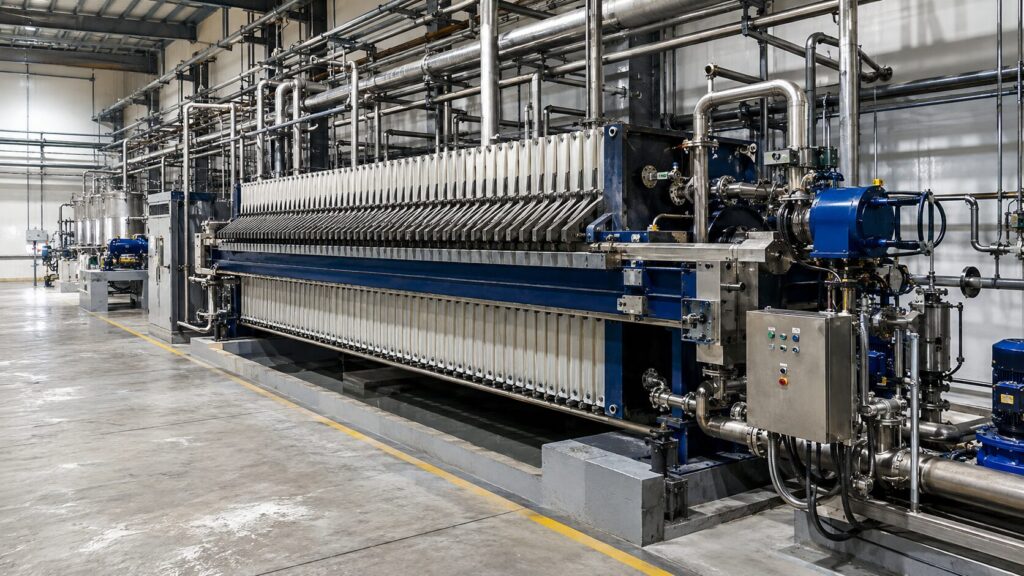
Solid-liquid separation using a filter press has been a fixture in industrial filtration for the better part of two centuries. Filter presses are alive and well in chemical plants, pharmaceutical facilities, and mineral processing operations around the world, and for good reason. When the application fits, a modern filter press is a proven, reliable, and cost-effective piece of equipment.
But filtration experts have long noted a tendency to reach for the filter press out of familiarity rather than suitability. The result is a filter that can technically do the job, but that accumulates operational costs, wash inefficiencies, and quality control problems that a more appropriate technology would avoid.
This post walks through what filter press filtration does well, where its inherent limitations create real operational problems, and which alternative technologies, including continuous pressure and vacuum systems, are worth evaluating when the application demands more than a filter press can reliably deliver.
How Filter Press Filtration Works, and Where It Came From
The filter press originated in clay field dewatering, where semi-colloidal, poorly draining material needed to be pressed to the lowest achievable moisture content. The design logic was straightforward: apply as much pressure as possible to force liquid out of a compressible solid.
That origin shapes the fundamental character of filter press operation. To produce a cake that holds together and discharges cleanly, filter presses require thick cakes, typically 25 to 50 mm. Thin cakes tend to stick to the cloth. Thick cakes mean long cycle times and manual intervention for cake discharge. Long cycle times mean batch-by-batch production with significant intervals between discharges.
Modern filter presses have addressed many of the mechanical problems that plagued earlier designs. Automatic plate moving systems, improved cloth materials, membrane compression devices, and electronic cycle controls have made today’s equipment significantly more reliable than its predecessors. The basic principle, however, has not changed. And neither have its inherent limitations.
The Real Limitations of Filter Press Operation
The limitations of filter press filtration are not design flaws that better engineering has eliminated. They are consequences of the thick-cake, batch-pressure model that define how the technology works.
Long and variable cycle times. Thick cakes take time to form and drain. As cake thickness increases, filtration time, pressure requirements, and final cake moisture all increase together. For continuous production environments, the periodic discharge of a batch filter creates an uneven filtrate stream that complicates downstream operations.
Wash inefficiency. Filter press cakes form on both sides of each chamber, producing a two-sided cake with compacted outer layers and softer material in the center. Washing requires liquid to travel in the opposite direction of the original filtrate flow, through both compacted layers, at a pressure at least twice that needed for single-sided filtration. This makes counter-current washing essentially impractical and increases wash fluid consumption by a factor of three to four compared to single-sided alternatives. For difficult or critical products, wash cycles of eight hours or more following three to four hours of dewatering are not uncommon.
Containment requirements. A filter press scaled to industrial throughput can have hundreds of meters of plate sealing perimeter. Even with well-maintained cloth and plate washing systems, a leak-free guarantee is difficult to provide. For hazardous materials, a gas-tight housing is required, adding capital cost and making cloth re-clothing a complex, time-intensive procedure.
Footprint and scaling. Scaling a filter press operation means adding plates, and eventually units. The apparent advantage of a large filter area per unit decreases when cycle time is factored in. In one documented installation, a 12 m2 CI-VBF replaced a 440 m2 batch filter press with matched throughput, because the continuous system produces output at a steady rate rather than in periodic batches.
Product quality variability. Cake quality in a filter press can vary plate-to-plate and within a single plate, particularly when settlement affects cake homogeneity in the vertically mounted chambers. For processes where consistent moisture content or impurity levels are a quality requirement, this variability is a meaningful risk.
When Filter Press Filtration Remains the Right Choice
None of the limitations above disqualify the filter press from consideration. For the right application, a modern filter press remains a well-proven, cost-effective option.
The critical issue is not whether a filter press can do the job. In many cases, it can. The issue is whether it is the best-matched technology for the specific process requirements. For applications where cycle time, wash efficiency, footprint, or containment are significant constraints, an evaluation of alternative technologies is worth conducting before specifying equipment.
Alternative Technologies for Industrial Solid-Liquid Separation
There are four alternative technologies that are commonly considered when filter press technology is not the optimal fit. The right choice depends on slurry characteristics, solids concentration, wash requirements, and whether continuous or batch operation is more appropriate.
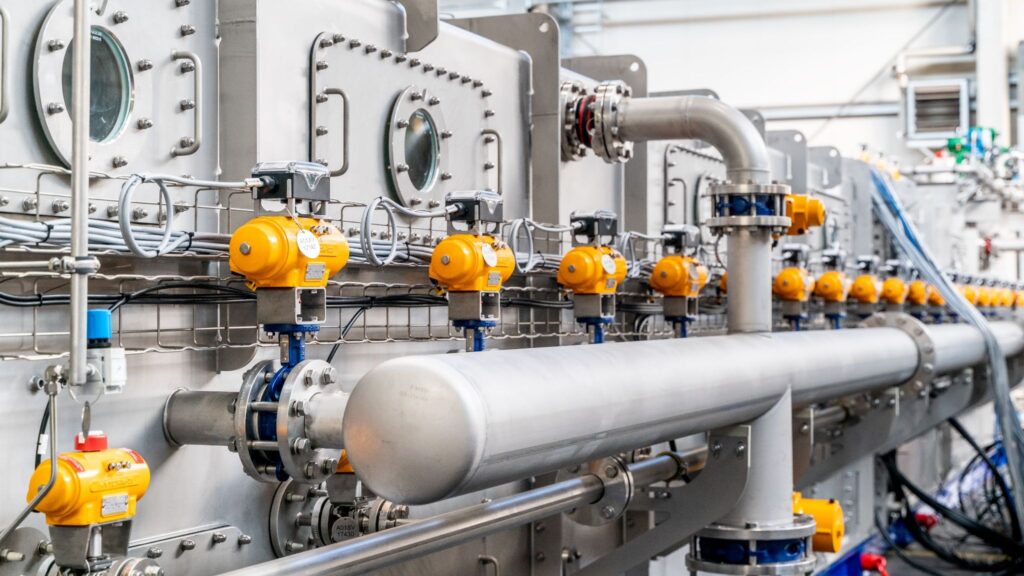
Rotary Pressure Filter (continuous pressure operation). The Rotary Pressure Filter (RPF) provides thin-cake, continuous production under pressure up to 90 psig. Filtration, washing, drying, and cake discharge all occur within a single enclosed unit across independently controlled process zones. Positive displacement and counter-current washing are both supported, and all solvent and gas streams can be recovered and recirculated. The RPF is well-suited for high-solids slurries in pharmaceutical, specialty chemical, and fine chemical applications where containment, wash purity, and consistent product quality are priorities. Because the filter operates continuously, filtrate output is constant rather than variable, which simplifies downstream integration.
Continuous-Indexing Vacuum Belt Filter (continuous vacuum operation). For high-solids slurries, up to 50 to 55 percent solids, where vacuum filtration is appropriate, the Continuous-Indexing Vacuum Belt Filter (CI-VBF) offers a highly efficient alternative to pressure-based batch filtration. Fixed vacuum trays, a continuously fed slurry system provide reliable cake formation, washing, and drying in a single pass. The plug-flow wash mechanism achieves high displacement efficiency, and mother liquor and wash filtrates can be recovered separately. In one documented installation, a 12 m2 CI-VBF replaced a 440 m2 batch filter press with matched throughput.B
Candle Filters (batch pressure, clarification and recovery). For low-solids slurries where clarification and solids recovery are the primary objective, Candle Filters offer full containment and automated operation in a compact pressure vessel. Filter socks capable of removing particles below 1 micron build cake on the exterior of vertical candles. Discharge is automatic via low-pressure gas expansion that fractures the dried cake and allows it to fall into the vessel cone. Candle filters are well-suited for applications where the filter press alternative would require a fully enclosed housing to meet containment requirements.
Pressure Plate Filters (batch pressure, clarification and recovery). Pressure Plate Filters are horizontal-plate alternatives to candle filters for clarification and recovery from low-solids liquids. The horizontal orientation supports cake structures that do not hold well vertically. Discharge is automated via plate vibration with gas assist. Like candle filters, they offer full containment and fine solids removal in the sub-micron range.
How to Evaluate Which Technology Fits Your Process
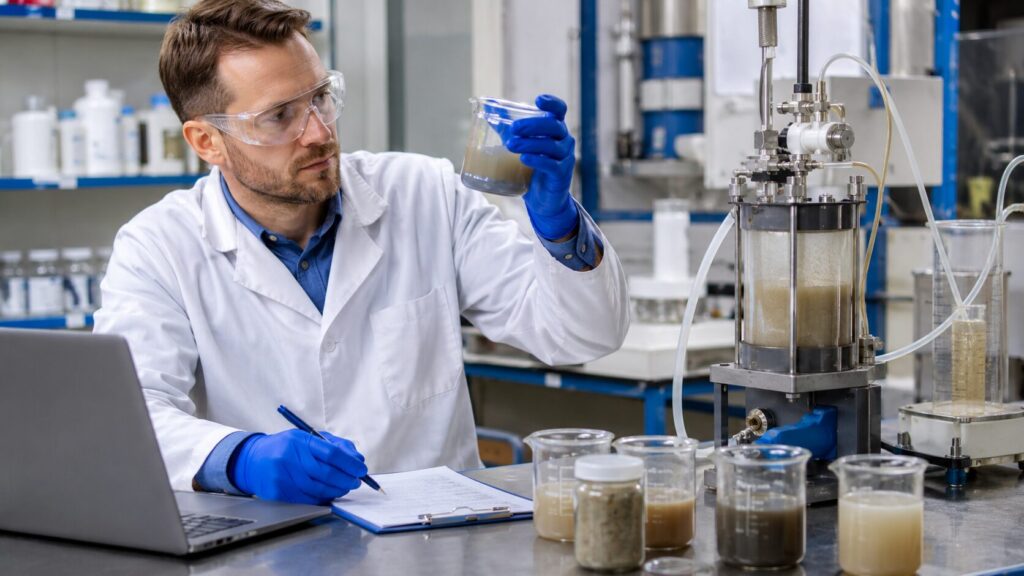
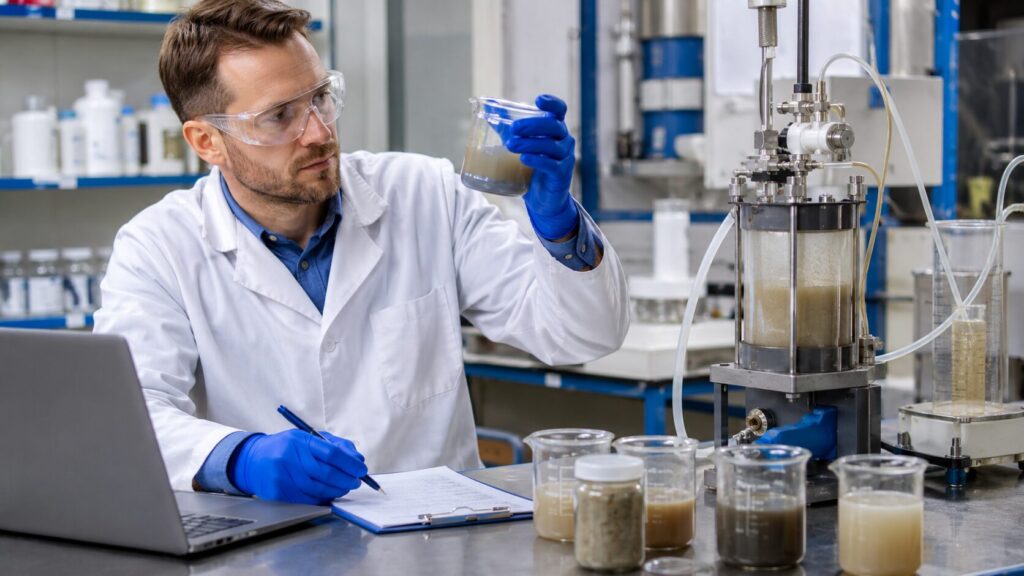
The most important thing a process engineer can do before selecting between filter press technology and any alternative is to test the actual process slurry. Filtration performance is process-specific. Particle size, solids concentration, cake compressibility, wash requirements, and drying targets all interact in ways that cannot be reliably predicted without measured data.
Laboratory bench-scale testing on the actual slurry determines whether vacuum or pressure filtration is appropriate, which filter media produces the required filtrate clarity and cake structure, what wash ratios achieve target purity, and what cycle times and drying conditions produce consistent output. This data forms the basis for technology selection and equipment sizing, and it eliminates the assumptions that lead to underperforming capital projects.
The comparison between industrial filtration options should ultimately be made on the basis of combined overall efficiency, total installed capital cost, operating cost, space requirements, and reliability, alongside the data that only process-specific testing can provide. A filter that looks cost-effective on a capital basis can be significantly more expensive in operating terms when wash fluid consumption, labor, maintenance, and downtime are included.
The Right Filter Starts with the Right Questions
Filter press filtration is not going away. For the applications it fits, it remains a practical, well-understood technology with a long track record. But the decision to specify a filter press, rather than a continuous pressure or vacuum alternative, should be made on the basis of process requirements, not familiarity.
The questions worth asking before specifying any solid-liquid separation equipment are the same:
- What does the slurry actually do under filtration conditions?
- What wash efficiency does the process require?
- What throughput, footprint, and containment constraints apply?
The answers to those questions, grounded in bench-scale test data, are what determine which technology is the right fit.
Talk to BHS about filtration for your process, or submit an Application Data Sheet to start the technical conversation.