

Sustainable Food Technology and the Next-Generation of Continuous Filtration
Sustainable Food Technology in Fermentation-Based Production
Sustainable food technology explores the process of how new ingredients are produced. Fermentation plants that manufacture amino acids, organic acids, vitamins, and plant-based food components are under pressure to improve yield, cut energy and water use, and reduce waste. All of these goals sit at the heart of sustainable food technology.
Yet in many facilities, the real bottleneck isn’t in the fermenter. It is in the solid-liquid separation step, where delicate crystals or biomass must be filtered, washed and dewatered before drying. When this stage relies on outdated batch equipment, it quietly undermines sustainability: energy use rises, water consumption increases and product losses mount.
Next-generation continuous filtration, especially modern thin-cake rotary pressure and belt filters, provides a practical path toward more sustainable food technology in fermentation plants. The following case, based on an L-threonine upgrade, illustrates how rethinking filtration can improve both productivity and resource efficiency.
From Fermenter to Final Product: Why Filtration Becomes the Bottleneck
A typical fermentation-based process for crystalline amino acids or similar products follows a familiar pattern: fermentation, cell separation and purification, crystallization, then separation of the crystal suspension into solid and liquid. That final separation step must do three jobs at once: remove mother liquor, wash out dissolved impurities and then dewater the cake to minimize load on the dryer.
The trouble is that crystal morphology, size distribution and solubility can vary dramatically from one product to another, even within the amino acid family. Research by Löbnitz and co-workers at KIT shows how different amino acids produce very different cake resistances, residual moistures and filtration behaviors, depending on whether the crystals are cubic, plate-like, or needle-shaped. What works acceptably for one product can be painfully slow or inefficient for another.
Meanwhile, competitive pressure pushes manufacturers to add new products more quickly. Traditional scale-up lab, then pilot plant, then full-scale—can take years. To shorten this path, the same researchers advocate modular, continuous miniplant systems, where each unit operation (including filtration) is a plug-and-play module that can be tested and then scaled.
In this context, filtration equipment must do more than simply “get the solids out.” It has to be:
- Continuous, to match large-scale production conditions.
- Scalable and predictable, with proven scale-up correlations.
- Flexible and robust, able to handle different crystal systems, washing strategies and operating conditions without complete redesign.
Batch filter presses, even automated ones, struggle to meet these demands.
When Batch Filters Hold a Fermentation Plant Back
Consider the experience of an American dietary supplement manufacturer producing the essential amino acid L-threonine. Like many facilities, they relied on horizontal automated filter presses to separate L-threonine crystals from diluted mother liquor in batch mode.
On paper, the presses performed the core separation. In practice, they created a cascade of productivity problems:
- Low reliability and frequent maintenance. Short maintenance intervals, labor-intensive cloth changes and expensive spares forced the plant into recurring downtime.
- Lengthy cleaning and changeovers. Manual cleaning took days and exposed operators to product and chemicals. Every six to eight weeks, the plant had to allocate a multi-day maintenance window.
- Mechanical damage to crystals. High pressing pressures fractured delicate L-threonine crystals, increasing fines and leading to product losses.
- Redundant equipment just to stay online. Because one press was regularly down for maintenance, a second press had to be installed purely as a backup.
All of this translated into lost production time, higher operating costs and a great deal of complexity for plant scheduling.
At the same time, the customer had very clear performance targets for any replacement system:
- Filtration of roughly 2,500 kg/h of L-threonine crystals
- Product purity above 98.5 %
- Residual cake moisture below 20 %
- Freshwater consumption below 0.12 L per liter of suspension
In other words, they didn’t just want a more reliable filter; they needed a solution that could meet strict quality, drying and water-use targets without rewriting the entire process.
Testing the Options: Belt Filter vs. Rotary Pressure Filter
BHS approached the problem the way it does with most fermentation and crystallization projects: with systematic testing. In the Charlotte, NC filtration lab, engineers evaluated both vacuum and pressure filtration options, exploring:
- Single-stage and multi-stage washing concepts
- Different cake thicknesses and wash ratios
- Routes with and without intermediate dehumidification
The most promising concepts were then taken into multi-week endurance tests, using real process streams to assess not only performance but also filter cloth life and long-term stability.
Two solutions emerged as strong candidates:
- 1. A continuous rotary pressure filter (RPF) with single-stage counter-current washing and an intermediate dehumidification step.
- 2. A continuous belt filter with two-stage counter-current washing and its own dehumidification stage.
Both systems handled the delicate L-threonine crystals gently, avoiding the breakage seen in the high-pressure filter presses. Both delivered the required purity and water consumption. From a purely separation-efficiency standpoint, the belt filter even offered slightly better wash performance and marginally lower water usage.
But process engineering is rarely decided by a single number.
The Retrofit Reality: Why the Rotary Pressure Filter Won
When BHS and the customer looked beyond the lab data to the full process context, the Rotary Pressure Filter emerged as the better overall fit.
The decisive factor was residual cake moisture and its impact on the existing dryer. While the belt filter could meet moisture specifications on paper, its typical residual moisture approached 25%, which would have overloaded the current dryer and forced major investment in new drying capacity.
The RPF, by contrast, consistently reduced residual moisture to below 19%, comfortably within the dryer’s operating window. That single difference meant the plant could keep its dryer, its utilities infrastructure and much of the surrounding process untouched.
Other advantages of the RPF became clear as well:
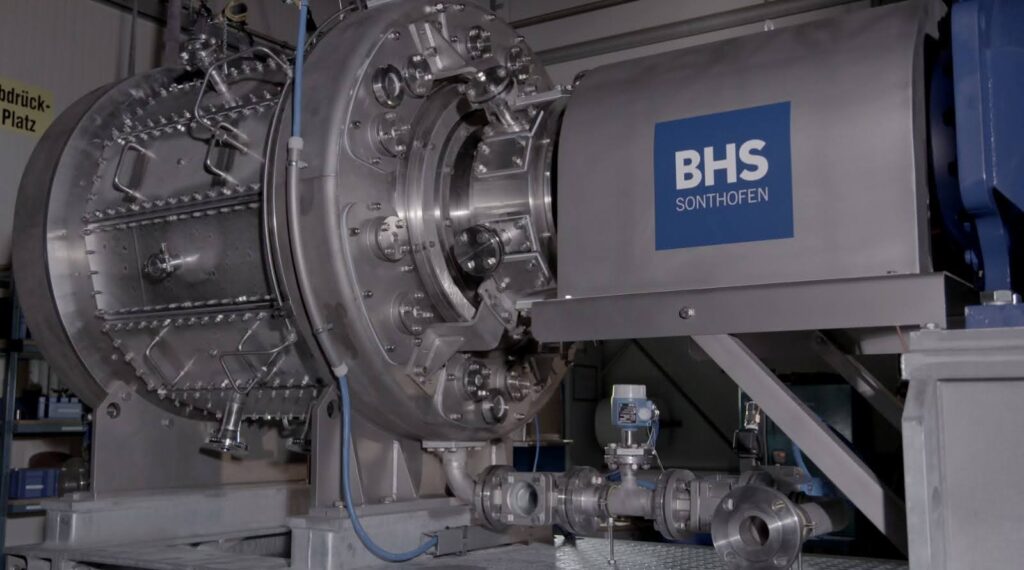
- Compact footprint and higher availability. One RPF A12 with just 2.88 m² of filter area replaced two automatic filter presses of about 6 m² each, freeing up space on the production floor and simplifying maintenance planning.
- Dramatically reduced maintenance effort. Routine maintenance time fell to roughly one-tenth of what the presses had required. Machine availability climbed to over 96 %, effectively eliminating filtration as a source of unscheduled downtime.
- Continuous, enclosed operation. Instead of cycling between fill, press, discharge and clean steps, the RPF provided a smooth, continuous flow of crystals, matching the upstream crystallizer and downstream dryer far more closely.
In short, the RPF met or exceeded the product-quality and efficiency metrics of the belt filter while aligning far better with the existing plant assets and productivity goals.
What “Next-Generation Continuous Filtration” Really Delivers
The L-threonine example illustrates several broader ways that modern continuous filters—rotary pressure filters and advanced belt filters—unlock productivity in fermentation plants.
1. Uptime Instead of Stop-Start Cycles
Continuous filters eliminate the inherent downtime of batch cycles. There is no repeated opening and closing, no waiting for operators to scrape cakes, and no long pressurization phases. A well-designed continuous filter becomes a quiet, steady heartbeat in the process, not a source of disruption.
High mechanical reliability and much longer cloth life further reduce planned and unplanned outages. For a fermentation plant, this translates directly into more fermenter campaigns per year and better alignment between upstream and downstream schedules.
2. Better Use of Dryers and Utilities
Dryers are among the most energy-intensive pieces of equipment in a plant. When filtration leaves high residual moisture in the cake, dryers have to work harder, consume more energy and often become the next bottleneck.
Next-generation continuous filters are designed specifically to optimize the interplay between filtration, washing and dewatering. With appropriate pressure, cake thickness and wash strategy, they can deliver cakes at the right moisture for the dryer, not just the best number on a lab spec sheet. That was the decisive factor in choosing the RPF for L-threonine, and it is just as critical for organic acids, vitamins or plant-based ingredients.
3. Gentler Handling of Delicate Crystals
Many fermentation products, L-threonine included, form crystals that are fragile and prone to breakage. Excessive mechanical stress generates fines, which are harder to filter and can hurt product quality.
Thin-cake rotary pressure and belt filters apply much less compressive stress than high-pressure filter presses or some centrifuges. Combined with carefully chosen cake thickness and flow paths, they maintain crystal integrity and help keep granulometry within specification, improving both filtration performance and final product properties.
4. Flexibility for New Products and Modular Plants
The KIT work on amino acid filtration emphasizes the need for flexible, robust separation modules that can cope with changing crystal properties and operating conditions, especially in modular miniplant concepts for faster scale-up.
Continuous filters support this flexibility in several ways:
- They allow easy adjustment of cake thickness, wash times and dewatering conditions for different products.
- Their long filtration zones can be divided into multiple washing and dewatering stages simply by repositioning wash headers or adjusting zone lengths.
- With proven scale-up rules, results from lab and miniplant trials can be translated into reliable full-scale designs, shortening time-to-market for new molecules.
For plants that expect to introduce new amino acids or fermentation products over the next decade, this adaptability is just as important as today’s throughput.
Choosing the Right Continuous Filter for Your Fermentation Plant
Rotary pressure filters are not the only answer, and BHS routinely supplies both pressure and vacuum belt filters for fermentation and crystallization duties. The choice depends on a mix of factors:
- What is the product’s phase: solid or liquid?
- How delicate are the crystals or biomass?
- What residual moisture and wash purity are required?
- Are solvents involved, requiring a gas-tight or explosion-protected design?
- How will the filter integrate with existing dryers, centrifuges or downstream steps?
This is why BHS emphasizes laboratory and pilot testing as the starting point. Bench-scale studies characterize cake resistance, washing behavior and dewatering potential for each product. Pilot trials then validate those findings under realistic conditions, including long-term effects on cloth life and fouling. Only then is a full-scale solution recommended—one that aligns with both product specs and plant constraints, as in the L-threonine example.
Turning Filtration into a Productivity Engine
In many fermentation plants, filtration still functions as a necessary evil, a black box that “just has to work” while the focus stays on fermentation and crystallization. The experience with L-threonine shows that this mindset can leave enormous value on the table.
By replacing aging batch presses with next-generation continuous filtration, plants can:
- Raise overall equipment effectiveness and reduce downtime
- Protect crystal quality and improve yield
- Reduce energy and water consumption
- Integrate smoothly with existing dryers and utilities
- Gain the flexibility to introduce new products quickly through modular, scalable separation modules
For producers of amino acids and other fermentation-derived ingredients, continuous filters like the BHS Rotary Pressure Filter and advanced belt filters are more than just new machines. They are tools for unlocking productivity across the entire plant and turning solid-liquid separation from a bottleneck into a competitive advantage.