

The Direct Battery Recycling Process
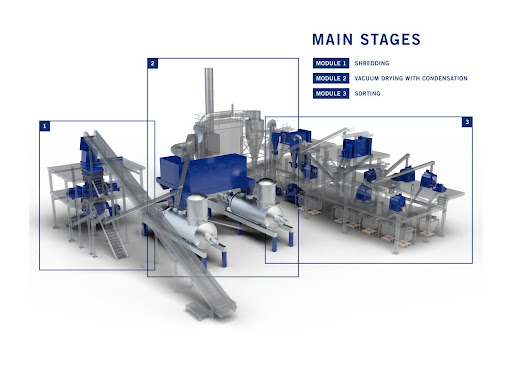
The Role of Direct Recycling in the Battery Recycling Process
Lithium-ion batteries are central to the electrification of transportation and renewable energy storage. But as volumes of end-of-life batteries increase, recycling technologies must evolve to reduce costs, minimize environmental impact, and recover materials efficiently.
While hydrometallurgical and pyrometallurgical processes dominate today’s recycling landscape, direct recycling is gaining attention as a promising complement. By focusing on recovering and reusing intact battery components, rather than reducing everything to raw metals, a direct battery recycling process offers a faster, less energy-intensive pathway to circularity.
How the Direct Battery Recycling Process Works
Direct recycling seeks to preserve and reuse valuable materials inside lithium-ion batteries, rather than breaking them down completely. The general workflow includes:
- Battery Shredding & Sorting
- Discharged batteries are mechanically shredded into smaller fractions.
- Sorting processes separate materials such as plastics, foils, and black mass.
- Electrolyte Removal via Vacuum Drying
- Vacuum drying extracts residual electrolytes from shredded material safely and efficiently.
- This step is critical to preparing cathode and anode powders for reuse, without introducing new chemical waste streams.
- Downstream Component Recovery
- Materials such as cathode active material and graphite are refined for reuse in new cells.
- Some processes integrate re-lithiation or surface treatments to restore performance.
The Importance of Vacuum Drying
Among all the steps in the battery recycling process, vacuum drying is pivotal—and it is here that BHS Process Technology brings its strongest expertise.
- Vacuum drying ensures complete removal of electrolytes from shredded material.
- This not only improves the quality of recovered powders but also enhances safety in downstream processing.
- Unlike chemical-based drying methods, vacuum drying reduces solvent use and lowers overall environmental impact.
BHS has demonstrated this expertise in industrial-scale plants, including BASF facilities, where vacuum drying systems were integrated as part of turnkey solutions.
BHS Capabilities Across the Recycling Workflow
Although BHS Process Technology now focuses on its core filtration and drying technologies, the company has proven capabilities in all three critical modules of direct recycling:
- Module 1 – Shredding & Sorting: BHS has engineered front-end systems for safe battery discharge, shredding, and separation.
- Module 2 – Vacuum Drying: BHS specializes in industrial-scale vacuum dryers, including patented processes (US11978928B2) for electrolyte recovery.
- Module 3 – Downstream Processing: BHS has delivered solutions for refining and recovering cathode/anode materials, ensuring compatibility with reintegration into new batteries.
This broad experience demonstrates deep process know-how—giving customers confidence that BHS vacuum drying solutions integrate seamlessly into larger recycling systems.
Why Choose BHS for Direct Recycling Processes
- Proven Industrial Deployments – Trusted by major players such as BASF for large-scale recycling systems.
- Vacuum Drying Expertise – Patented technologies that ensure efficient electrolyte removal.
- Scalable & Sustainable – Continuous systems designed for industrial throughput, lower energy use, and reduced chemical consumption.
- Process Integration Knowledge – Decades of experience across the full recycling workflow ensures system compatibility and efficiency.
Direct recycling offers a sustainable path forward for lithium-ion battery recovery by preserving high-value materials and reducing chemical processing. Within this approach, vacuum drying stands out as a critical enabling step, and BHS Filtration is a global leader in delivering the technology that makes it possible.
With its proven systems, industry partnerships, and experience across shredding, drying, and downstream processing, BHS combines technical expertise and process understanding to help customers scale their direct recycling operations successfully.
Connect with a BHS engineer to discuss how our solutions can support your battery recycling process.