

Water and Energy Saving Approaches in Rare Earth Element Processing
The Water Challenge in Rare Earth Element Processing
Mining and chemical refining are among the most water-intensive industries in the world. Rare earth element processing is no exception. Large volumes of water are consumed at every stage, from ore grinding and leaching to dust suppression and tailings management.
This challenge is even more acute because many rare earth mines and refineries are located in arid or desert regions, where water is scarce and demand already competes with local ecosystems and communities.
Reducing water consumption in rare earth element processing is not just an environmental priority; it is a strategic necessity for operators:
- Lowering operating costs by cutting utility and wastewater treatment expenses.
- Meeting sustainability goals to align with corporate and government mandates.
- Securing long-term permits in water-stressed regions where regulators scrutinize water usage closely.
Why Water Efficiency Matters in Rare Earth Element Processing
Water-intensive operations face a triple burden:
- High Utility Costs – Sourcing and treating water adds significant cost to refining operations.
- Community & Ecosystem Impacts – Overconsumption strains already limited water supplies, potentially creating conflicts with surrounding communities.
- Regulatory Pressure – Governments worldwide are tightening water usage and discharge limits, making efficiency a compliance requirement.
Improving water efficiency is about more than cost savings. It is a way to demonstrate environmental stewardship while also building economic resilience in a competitive global supply chain.
How BHS Indexing Belt Filters Reduce Water Use
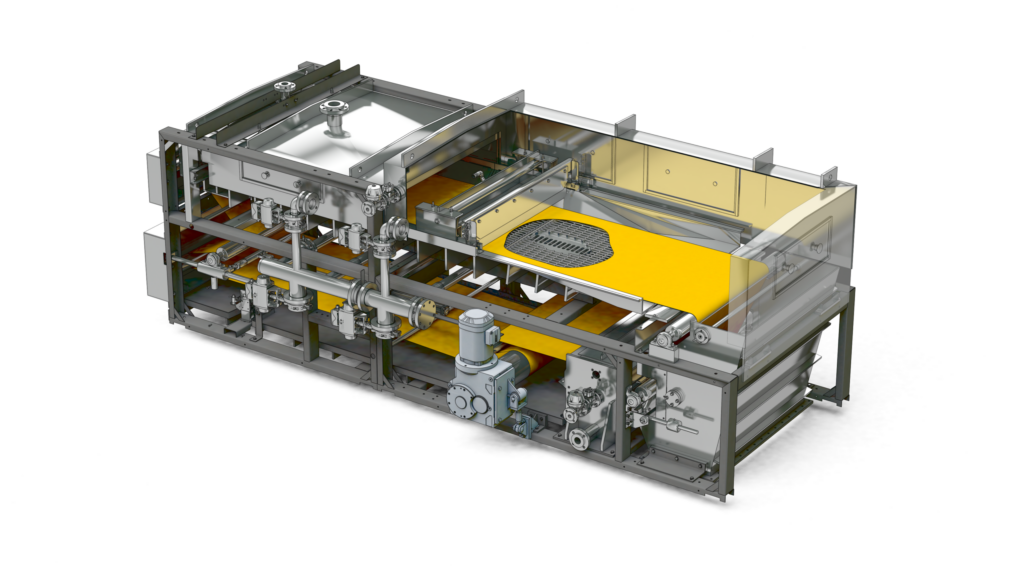
BHS Indexing Belt Filters (IBFs) are engineered to combine high washing efficiency with minimal water demand, setting them apart from conventional filter presses and rubber belt filters.
True Plug Flow & Displacement Washing
Filter presses and rubber belt filters often experience channeling, where wash liquid bypasses parts of the cake. BHS IBFs deliver controlled plug flow, ensuring impurities are removed completely while using less wash water.
Countercurrent Washing Efficiency
Countercurrent washing is fully enabled in BHS IBFs, reducing wash water use by 30–50% compared to co-current washing designs, while still achieving high-purity products.
Stationary Tray Design
Rubber belt filters require continuous seal water to lubricate glide belts. The BHS stationary tray design eliminates seal water consumption entirely, removing a hidden but significant water draw.
Closed-Loop Vacuum Pumping
Vacuum pumps with integrated heat exchangers and recirculation loops cut fresh seal liquid demand, allowing for efficient recycling of process fluids.
Smart Belt Washing
Cloth wash sprays activate only during belt indexing, reducing water consumption by 50% or more compared to continuous sprays.
Recycling Streams
- Belt wash water is reused as cake wash water.
- Filtrate is routed to recycle tanks for closed-loop operation.
Lower Maintenance Wash Needs
With automatic cake discharge and efficient cloth cleaning, manual hosing is minimized—further reducing operator-driven water consumption compared to filter presses.
Simplified Plant Water & Effluent Management
The benefits of BHS IBFs go beyond direct water savings. By enabling efficient wash and recycle loops, plants see:
- Lower intake costs from reduced freshwater demand.
- Lower treatment and discharge costs thanks to smaller wastewater loads.
- Reduced environmental footprint, a critical factor in maintaining a social license to operate in sensitive regions.
Water Consumption Comparison of Filtration Technologies
| Category | Filter Press | Rubber Belt Filter | Indexing Belt Filter (BHS) |
| Cake Washing | Limited efficiency; channeling common → requires high wash volumes | Channeling reduces efficiency; requires excess wash | Plug flow + displacement washing → efficient, less water needed |
| Countercurrent Washing | Not practical | Rarely implemented | Fully enabled → 30–50% savings |
| Seal Water Usage | None | Continuous seal water for glide belts | None (stationary tray design) |
| Cloth Washing | Manual hosing, high operator water use | Continuous sprays consume large volumes | Intermittent sprays only during indexing → up to 70% savings |
| Water Recycling | Limited reuse; filtrate and wash water often mixed | Some recycle possible, but difficult balance | Closed-loop operation → wash water reused, filtrate directed to recycle tanks |
| Wastewater Load | High | Medium–high | Low, optimized recycle streams |
| Overall Water Demand | High | Medium–high | Low (30–60% savings) |
Aligning Efficiency with Sustainability Goals
Adopting water-efficient filtration systems creates value on multiple fronts:
- Environmental Impact: Reduced water consumption and wastewater volumes minimize strain on ecosystems.
- Economic Competitiveness: Lower utility and treatment costs free resources for reinvestment.
- Regulatory Compliance: Supports alignment with tightening global water usage and discharge regulations.
- Reputation & ESG Goals: Demonstrates commitment to sustainable rare earth element processing, an increasingly important factor for investors, governments, and surrounding communities.
Water scarcity is one of the most pressing challenges in rare earth element processing. Addressing it requires both innovation and proven engineering solutions.
BHS Indexing Belt Filters provide a comprehensive approach: continuous operation, superior cake washing, closed-loop water recycling, and zero seal water demand. By reducing water consumption by 30–60%, BHS systems lower operating costs, minimize environmental impact, and enable long-term sustainable operations.
Contact BHS Filtration to explore water- and energy-saving solutions for your REE operations.