

Why Benchtop & Pilot Testing Is Critical in Industrial Filtration Projects
Identifying & Avoiding Common Pitfalls in Lab- and Pilot-Scale Solid-Liquid Filtration TestingI
In industrial filtration projects, the fastest way to lose time and budget is to “prove” a filtration concept in the lab, then discover at plant scale that the data doesn’t translate. It happens more often than most teams expect: lab conditions drift, equipment is pushed outside realistic limits, or the process goals weren’t clearly defined from the start.
Benchtop and pilot testing are still the best tools we have for filtration technology selection and scale-up, but only when the tests are planned and executed with scale in mind. Below are hard-earned, practical lessons that help teams generate reliable filtration data, avoid false conclusions, and de-risk capital decisions.
BHS works with process engineers and project teams every day to turn bench results into full-scale success, supporting industrial filtration projects with lab testing, pilot trials, rental systems, engineered equipment, and long-term technical support.
Why small-scale filtration testing fails so often
Lab and pilot filtration tests are critical to technology selection, process optimization, and scale-up. Yet many industrial filtration projects still run into the same downstream problems because early testing was
- Non-representative of full-scale operation
- Inconsistent from run to run
- Misaligned with end-process requirements
- Designed around “what’s easy in the lab,” not what’s feasible in the plant
Small mistakes early can lead to:
- Non-scalable data and poor sizing assumptions
- Misleading performance conclusions (rate, washing, dryness)
- Expensive redesigns during detailed engineering
- Avoidable delays at commissioning
This post walks through common pitfalls and the best practices that keep lab and pilot testing anchored to real-world operating limits.
What is benchtop filtration testing, and why it matters
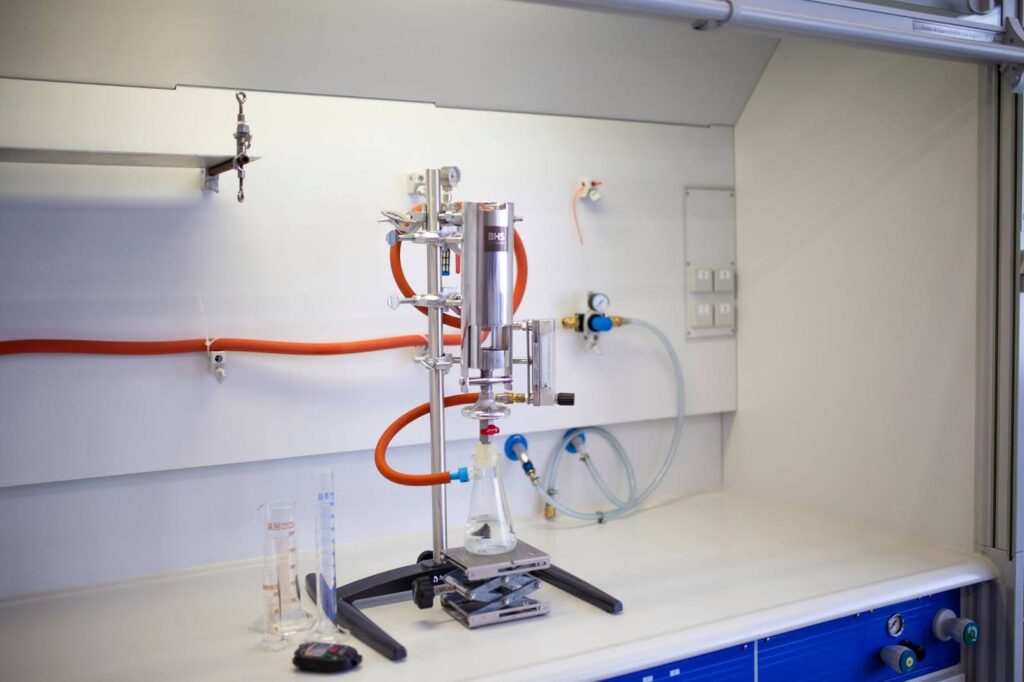
Benchtop filtration testing uses small-scale filters to simulate key elements of full-scale filtration: slurry behavior, filter media selection, filtration rate, cake formation, cake washing, and (sometimes) gas-assisted dewatering/drying.
Common objectives in benchtop testing
In early-stage industrial filtration projects, benchtop tests typically focus on:
- Filter media screening (compatibility, retention, blinding behavior)
- Filtration rate measurement (resistance, compressibility, cycle time implications)
- Cake washing efficiency (displacement, diffusion, achievable purity targets)
Key advantages
- Fast, cost-effective, and repeatable when controlled properly
- Excellent for narrowing technology choices before pilot-scale investment
- Helps teams avoid guessing, and puts math behind selection and sizing
Key limitations
- Harder to control every variable (especially temperature and slurry stability)
- Scale effects can distort performance if you’re not careful (edge effects, heat loss, handling losses)
The bottom line: benchtop data can be highly predictive if you design the test to be representative of full-scale operation.
Pitfall #1: Failing to plan for safety
R&D work is non-routine by definition, and it carries higher risk, especially when your slurry contains solvents, reactive solids, or hazardous byproducts.
Common oversights
- Skimming the SDS instead of planning around it
- Using incompatible materials of construction (seals, elastomers, plastics, metals)
- No spill response plan, disposal plan, or ventilation review
- Treating pilot work like a “bigger lab test” instead of a process operation
Best practices that keep testing safe (and productive)
- Start with inert simulants when possible to validate mechanics and procedures first
- Begin with low pressure and small slurry volumes, then scale up in controlled steps
- Adjust the test plan based on hazard level (containment, inerting, grounding, monitoring)
For many industrial filtration projects, safety isn’t just compliance; it’s the difference between a clean test campaign and weeks of preventable interruption.
Pitfall #2: Testing without a clear destination
One of the most costly testing mistakes in industrial filtration projects is running “interesting” filtration trials without defining what success looks like at full scale.
The right sequence for filtration development
- Define process needs
- Throughput targets
- Product purity requirements
- Acceptable residual moisture
- Solvent recovery goals
- Containment and operator exposure constraints
- Select candidate technologies that could realistically meet those needs
- Design test parameters around the operating principles and limits of those technologies
When teams skip this alignment, they often generate data that can’t be used for sizing, economics, or equipment selection, meaning the tests don’t reduce uncertainty (they just consume time).
BHS’s process-driven approach—collaboration first, then testing, then design—exists to keep industrial filtration projects moving forward with data you can actually scale.
Pitfall #3: Not understanding your filter
Benchtop testing should simulate full-scale operation, not invent a new filtration mode that won’t exist in the plant.
Critical considerations
- Filter media compatibility: retention, blinding, chemical resistance
- Operating pressure limits: don’t exceed what your candidate technology can deliver safely and consistently
- Cake height constraints: lab cake thickness must map to a realistic production cake thickness
- Washing and drying steps: sequence, driving force, and achievable endpoint matter
Why working with OEMs early matters
In many industrial filtration projects, teams involve equipment suppliers after lab work is “done.” That’s often too late.
Working with an experienced OEM early provides:
- Guardrails on realistic operating limits
- Faster troubleshooting when behavior is unexpected
- Better confidence that your data supports equipment sizing and scale-up
BHS Filtration, for example, supports bench-scale and pilot testing through its process development lab (Charlotte, NC) and provides written test reports with methodology, results, and scale-up recommendations.
Pitfall #4: Running tests without predictable results
Filtration data needs to be repeatable and mathematically consistent, or it’s not sizing data.
What “good” filtration data looks like
- Filtration time increases predictably with cake thickness/solids loading
- Wash rates remain consistent at equal conditions
- Variability between repeats is low enough to support decisions
Warning signs your data is not reliable
- Inconsistent washing times at the same conditions
- High variability between “identical” repeats
- Slurry degradation (settling, agglomeration, crystal growth, temperature drift)
- Sampling errors or poorly mixed feed containers
Best practice: duplicate or triplicate critical tests
If you’re making a major equipment decision in an industrial filtration project, treat key test points like you would any other critical measurement: repeat them. If you can’t reproduce it, you can’t bank on it.
Pitfall #5: Designing an unscalable process
Labs make it easy to do things that are not feasible at full scale, especially when chasing speed.
Common scale-up mistakes
- Excessive filtration rates that exceed hydraulic loading limits in production equipment
- Unrealistic drying gas consumption (easy to “throw gas at it” in the lab)
- Cake cracking, channeling, or bypass during dewatering
- Ignoring real utility and balance-of-plant constraints
Best practices for scalable test design
- Stay within realistic hydraulic loading limits for the candidate technology
- Measure gas usage early if gas-assisted drying/dewatering is part of the concept
- Favor drying strategies that scale predictably (and don’t depend on “perfect” lab handling)
BHS Filtration specializes in thin-cake technologies designed around continuous filtration, washing, and drying, so scale-up discussions can be grounded in real operating envelopes rather than lab-only performance.
Pitfall #6: Underestimating small-scale challenges
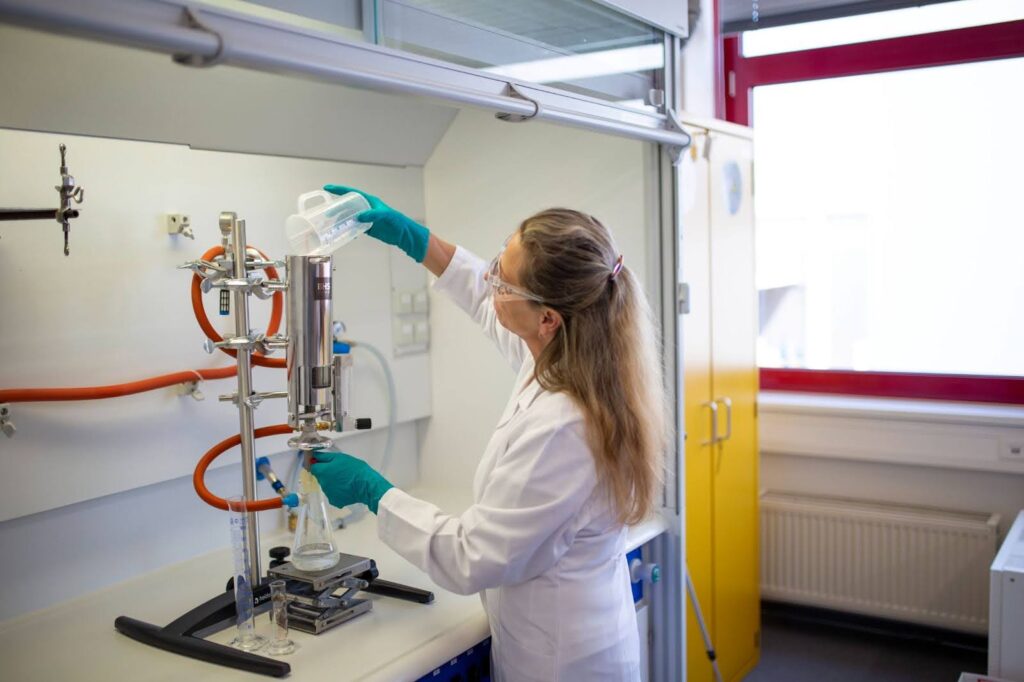
Even when the fundamentals are right, lab testing introduces issues that don’t show up at scale.
Common small-scale distortions
- Rapid heat loss and temperature drift
- Cake disturbance during washing (especially with aggressive wash application)
- Edge effects, cake shrinkage, and wall bypass
- Over-filtration that changes cake structure and makes results look “better” than reality
Practical solutions
- Use jacketed filters or temperature control where temperature impacts viscosity or solubility
- Apply gentle, controlled wash to avoid eroding or cracking the cake
- Avoid over-filtration; stop at endpoints that mirror full-scale cycles
These details matter because many industrial filtration projects fail not because of “Can we filter it?” but because of “Can we filter it reliably, repeatedly, and economically at production scale?”
10) Automation and continuous operation requirements
Large plants demand fewer manual steps, fewer exposed operations, and more consistent output. Increasingly, filtration must integrate into automated production environments with PLC control, stable cycle timing, and minimal intervention.
This is a major reason modern cake filtration systems emphasize automation, continuous designs, and reduced operator dependency.
Pilot-scale pitfall: Slurry handling and setup
At pilot scale, the #1 challenge is often not the filter; it’s moving slurry consistently and safely through the system.
Common pilot-scale issues
- Plugging feed lines and valves
- Poor pump selection (shear damage, cavitation, inability to handle solids)
- Insufficient instrumentation (no idea what pressure/flow is actually doing)
- No planned sampling points, making results hard to interpret
Best practices that save pilot campaigns
- Oversize lines and choose pumps designed for solids-bearing slurries
- Include recirculation loops to maintain homogeneity
- Install local pressure and flow monitoring (don’t rely on a single upstream gauge)
- Plan sampling points for feed, filtrate, and wash streams
BHS Filtration supports industrial filtration projects with pilot systems (including skid-mounted options), rental equipment for plant trials, and test reporting that ties pilot results back to full-scale sizing.
Planning Industrial Filtration Projects is the real scale-up tool
Benchtop and pilot testing are powerful when used correctly. The difference between “lab success” and “plant success” usually comes down to planning and realism.
The best filtration test campaigns are built around:
- Clear process goals and acceptance criteria
- Realistic operating limits tied to candidate technologies
- Repeatable test design that produces consistent, scalable data
- A dynamic, iterative approach that updates the plan as you learn
In industrial filtration projects, good testing shortens timelines, reduces risk, and leads to better technology decisions before major capital is committed.